
×
Fifty years ago, communities across the country celebrated the 200th anniversary of the Declaration of Independence with parades, historic reenactments, concerts, preservation projects, and patriotic displays. But in Charleston, a city where Revolutionary War history is a part of the landscape, the Bicentennial carried special meaning. The events of 1776 are still visible here in Fort Moultrie on Sullivan’s Island, at the Old Exchange and Provost Dungeon, in White Point Garden, and in the colonial churches, homes, and civic buildings that still stand in the city today.
In Charleston, the Bicentennial – along with the recent memory of the 1970 Tricentennial of the founding of the city – renewed interest in historic preservation and public history. It created a deeper appreciation for colonial and Revolutionary-era places in a city that was then known largely for the birthplace of the Civil War. Today, as we prepare to commemorate the Semiquincentennial, those themes return: honoring the past, preserving historic places, and celebrating the people and events that helped define both South Carolina and the nation.
As the country prepares for its 250th anniversary this July 4th, let’s look back Charleston’s role in the nation’s last milestone birthday.
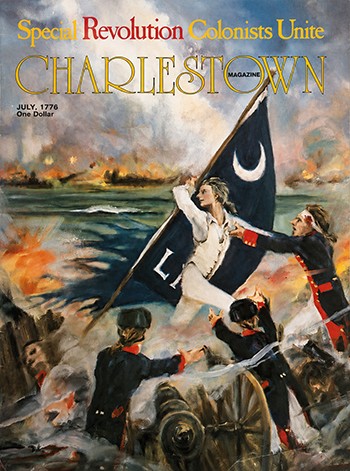
When Americans think of 1776, they often picture Philadelphia and the signing of the Declaration of Independence. Charleston, however, played a critical role in the fight. By 1776, it was one of the most important, cultured, wealthy, and influential cities in the colonies. Its maritime trade routes were closely tied to England, so its residents were deeply divided over the question of independence.
On June 28, 1776, South Carolina militia forces stationed on Sullivan’s Island at what is now Fort Moultrie successfully repelled a powerful British naval attack in one of the first major Patriot successes of the war. The victory became known as the Battle of Sullivan’s Island and is still celebrated annually as Carolina Day. The image of palmetto tree fortifications absorbing enemy cannon fire is enshrined on our state flag today.
Just days later, the Declaration of Independence was formally adopted. When the news reached Charleston later that summer, its enthusiastic reception established a tradition of Independence Day observances that has continued for nearly 250 years.
Many of the places associated with those events can still be visited today. Fort Moultrie still overlooks Charleston Harbor. St. Michael’s Church, whose bells rang during the Revolutionary era, still stands at the corner of Broad and Meeting Streets. The Old Exchange and Provost Dungeon remains one of the city’s most important landmarks. It’s also recognized as one of the 3 most historic surviving colonial public buildings in the United States (along with Independence Hall in Philadelphia and Faneuil Hall in Boston).
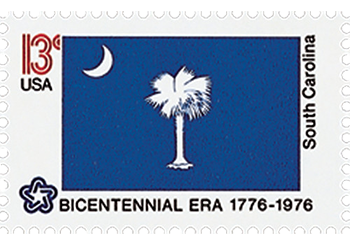
Like much of the nation, Charleston embraced the Bicentennial with enthusiasm. Its Revolutionary history made it a natural centerpiece of South Carolina’s commemorations. The official American Revolution Bicentennial Administration (ARBA) report included Charleston among the “cities that had been part of the American Revolution” along with Boston, Savannah, and Lexington and Concord.
Museums, preservation organizations, schools, civic groups, and local commissions sponsored exhibits, lectures, tours, and public programming. Many of these focused on restoring historic sites and creating lasting improvements rather than one-time events. Even though Charleston had already become a national leader in historic preservation by 1976, the Bicentennial helped reinforce that commitment.”
Specific events and projects still in the public memory include:
The patriotic spirit extended to homes, businesses, and public spaces that displayed red, white, and blue. Residents and visitors showed renewed attention to and pride in historic sites. At the time, Charleston’s reputation as a preservation-minded city was already well established. But the Bicentennial gave the movement fresh energy and a national context. It reminded residents that their streets, houses, churches, public buildings, and waterfront were part of a much larger American story. However, the commemoration was not only about looking back. Perhaps the lasting legacy of the Bicentennial here was not parades or banners. It was the reinvigorated public preservation movement that helped shape the Charleston we know and love today: a city where centuries-old architecture remains a living part of the urban landscape.
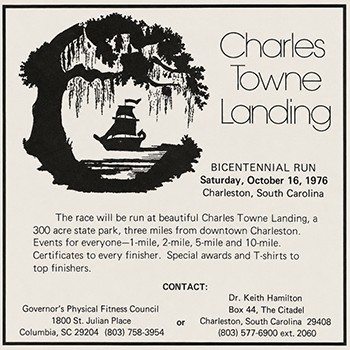
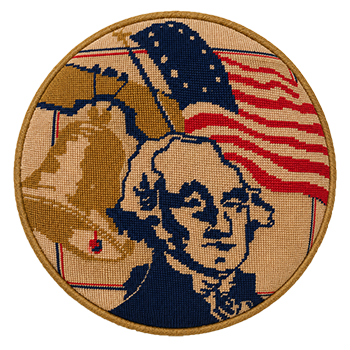

Today, few cities are better suited to commemorate the nation’s 250th birthday than Charleston. In fact, the United States Semiquincentennial Commission Act of 2016 specifically directs the organization of events "in locations of historical significance to the United States," specifically Boston, Philadelphia, Washington DC, New York City, and Charleston. SC250 Charleston and related organizations are planning a wide range of events, including Carolina Day commemorations, Revolutionary War lectures and exhibits, family programs, historic house tours, bell-ringing ceremonies, waterfront celebrations, and a major Independence Day celebration at Waterfront Park.
The events of 1776 are not preserved only in textbooks here, but in the city’s architecture, waterfront, churches, museums, and public spaces. The Bicentennial celebrations of 1976 recognized that connection between past and present. As Charleston prepares for the Semiquincentennial, residents and visitors will once again have the opportunity to experience a city where history is not simply remembered, but lived every day. Remember this when you visit Fort Moultrie or the Old Exchange and Provost Dungeon. When you take your children on a tour of Charles Towne Landing or Patriots Point. When you walk down Meeting Street or Broad Street. When you look up at St. Michael’s and St. Philip’s steeples. You are not just walking through history, you are a living part of it. How will you add your footprint to the city’s next steps in celebration and preservation?
Monday to Friday: 9:00 am - 5:00 pm
Copyright © 2026 Disher, Hamrick & Myers, Inc. All Rights Reserved.
Website Design by OBS


